
The Colours of Narrowband Solar Photography

When we think of the Sun, the image that immediately comes to mind is a bright, warm, yellow sphere in a blue sky. However, this golden-yellow appearance is largely a visual convention: a way of making solar photographs look like what our everyday experience tells us the Sun should look like.
This is why, when we colour our solar images, we often try to reproduce those familiar orange, yellow and golden tones.
But the reality is quite different.
Seen from space, outside the Earth’s atmosphere, the Sun emits light that appears white, with a slightly warm tint, because its radiation covers the entire visible spectrum.
When sunlight reaches the Earth’s atmosphere, it interacts with air molecules and is scattered in different directions. Shorter wavelengths (blue) are scattered much more strongly than longer wavelengths (red).
This is why the sky appears blue during the day, while the Sun often takes on its familiar yellow and golden tones, as part of its blue light has been scattered by the atmosphere. This phenomenon is known as Rayleigh scattering.
When astronomers and astrophotographers observe the Sun using specialised filters that isolate very narrow wavelength bands, the resulting image has no colour. It is a monochrome image, recorded in shades of grey.
Why? Because camera sensors, including those used in colour cameras, are made up of millions of light-sensitive pixels that do not measure colour directly.
In RGB sensors, red, green and blue filters placed over individual pixels determine which wavelengths reach each pixel. The camera then reconstructs the colour image through processing. However, this comes at the cost of some resolution and sensitivity.
In scientific solar photography, the priority is to capture as much light as possible at a particular wavelength, such as H-alpha, which is especially useful for studying the solar chromosphere.
For this reason, monochrome sensors without a Bayer colour filter array are generally preferred, allowing us to obtain better sensitivity and detail.
However, each spectral line — H-alpha, H-beta or Mg b1 — corresponds to a particular wavelength within the visible spectrum, and therefore to a colour that the human eye can perceive.
If we apply an RGB colour corresponding to the wavelength recorded by each filter, we can create a representation that is closer to the actual colour of that light.
Mg b1 — 518.4 nm
RGB (47, 255, 0)
A vivid emerald green, located near the centre of the visible solar spectrum.

H-beta — 486.1 nm
RGB (0, 239, 255)
A turquoise-blue colour associated with this hydrogen spectral line, allowing us to observe a different region of the solar chromosphere.
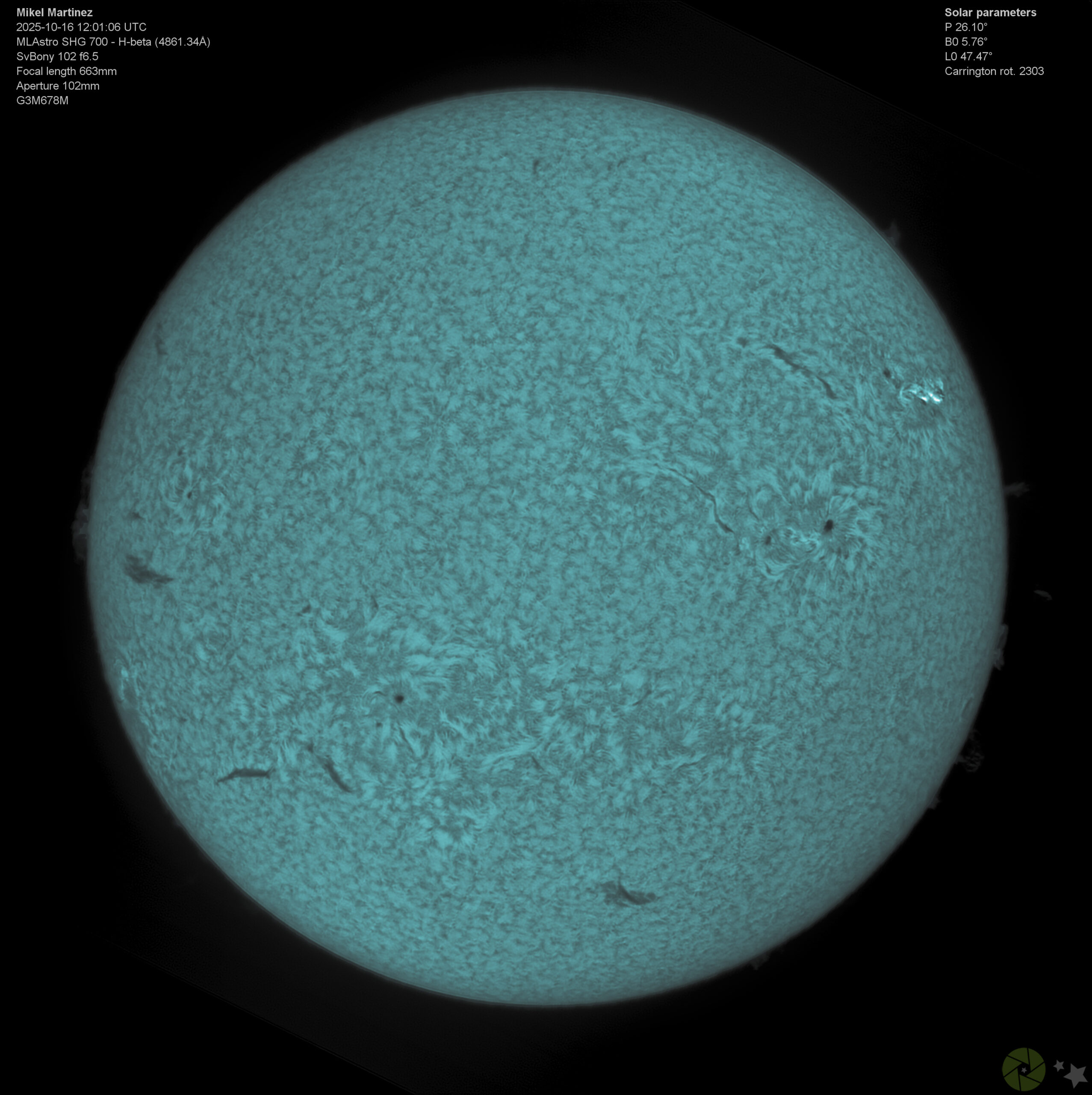
H-alpha — 656.3 nm
RGB (255, 0, 0)
A deep red, corresponding to the wavelength commonly used to observe some of the most spectacular features of the chromosphere: filaments, prominences and spicules.

When colourising our images in this way, we have to decide whether our aim is purely aesthetic or whether we want to get closer to a physical representation of colour.
Rather than simply choosing colours because they look attractive or familiar, we can try to establish a more direct connection between the light emitted by the Sun and the way our eyes perceive it.