
Eta Carinae: Exploring the Great Nebulae of the Southern Sky
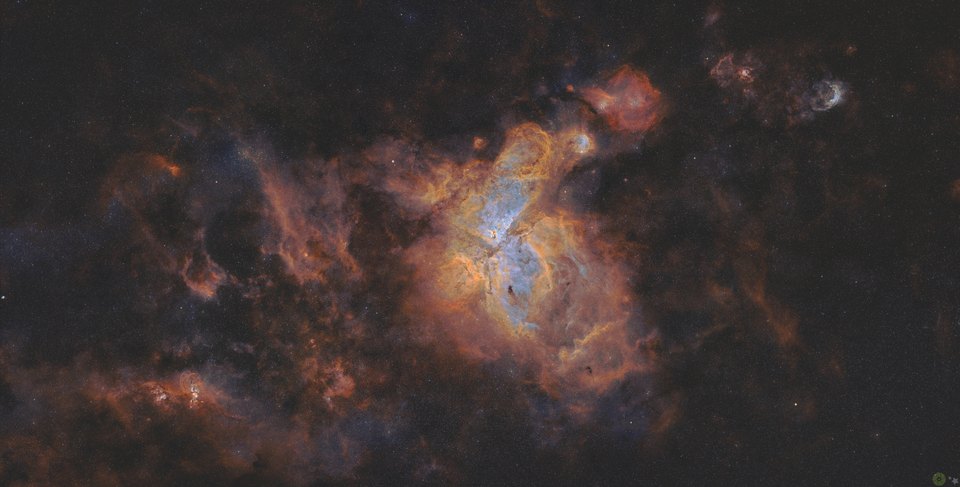
The Great Orion Nebula, M42, is probably the best-known and most photographed nebula in the sky. Much of its popularity comes from being relatively close to us and easy to observe from the Northern Hemisphere. But when we turn our attention to the southern sky, we find star-forming regions that are much larger and just as spectacular.
One of them is the Great Carina Nebula, NGC 3372, located about 7,500 light-years away.
The image opening this article is a six-panel mosaic showing not only this impressive nebula, but also several other regions of the sky filled with glowing gas, dark clouds of dust and clusters of young stars.
There is so much going on in this image that many details are difficult to appreciate when looking at the whole mosaic. I recommend opening it at full size and using the zoom to explore it. There is a lot to discover among those clouds of gas and dust.
A Huge Star-Forming Region
NGC 3372 stretches across more than 300 light-years and contains many young stars, some of them extremely massive and luminous.
Their intense ultraviolet radiation ionizes the surrounding gas, while powerful stellar winds carve out cavities, compress clouds of gas and shape many of the structures we can see in the image.
Among these stars is Eta Carinae, a binary star system whose primary component is one of the most extreme stars known. In the mid-19th century, it went through a massive eruption, ejecting an enormous amount of material into space. This material formed the small bipolar nebula known as the Homunculus.
Small, of course, only when compared with the enormous size of the whole nebula.
A Sky Without Stars
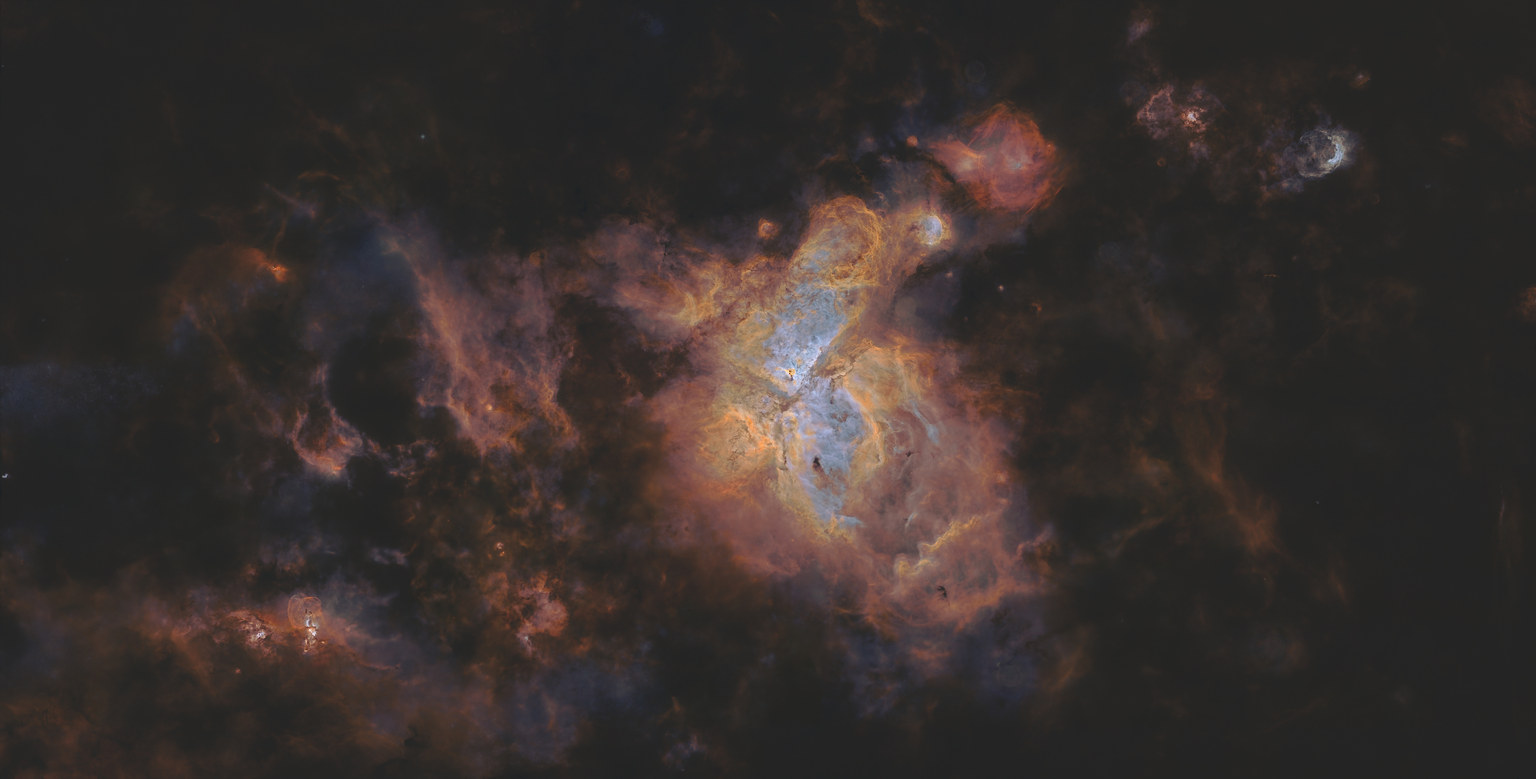
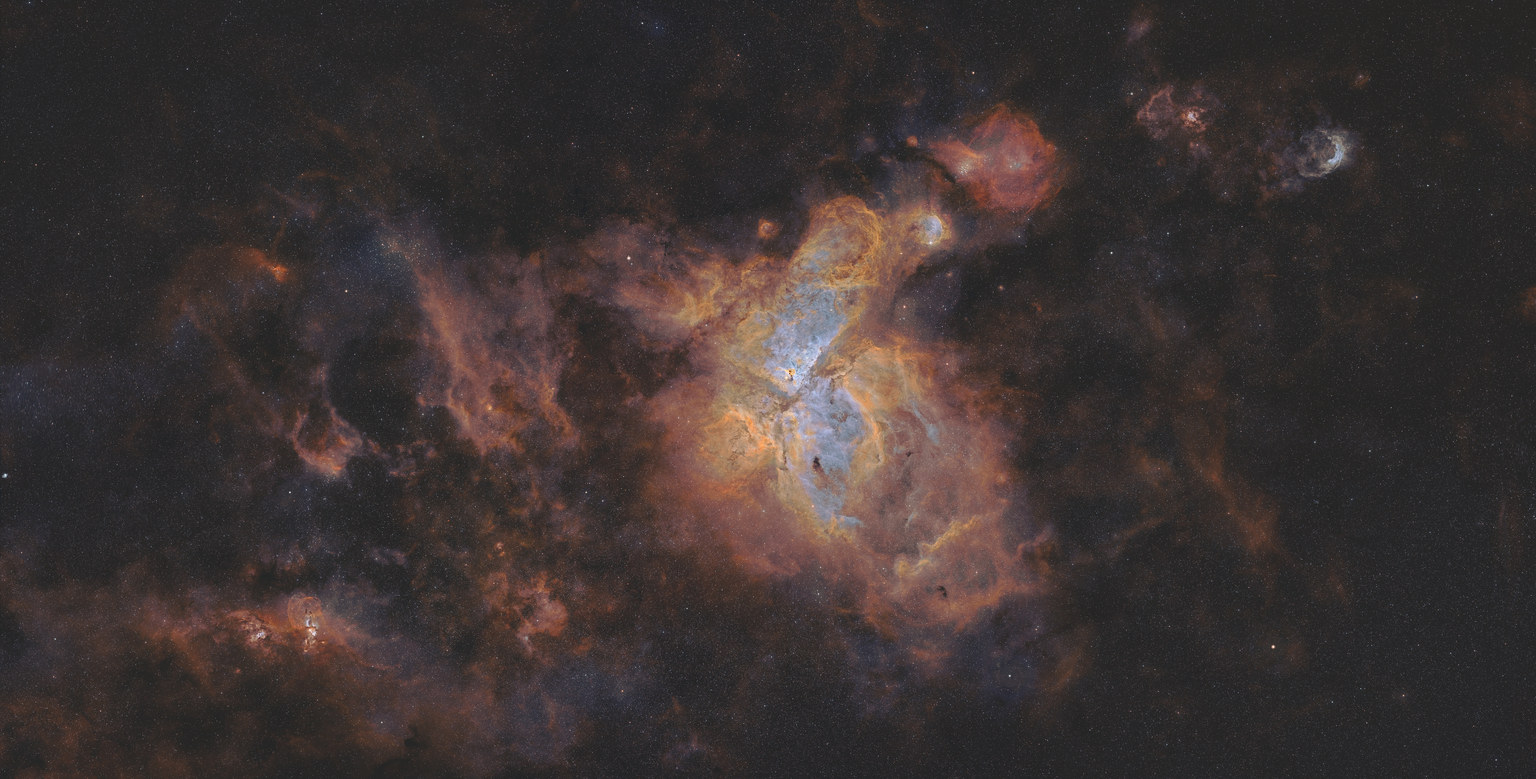
In a field located right in the Milky Way, the number of stars is enormous. They are an essential part of the scene, but their brightness can also make it difficult to see the faintest structures in the nebulae.
Modern image-processing techniques allow us to separate the stars from the nebulosity and examine the gas and dust without so much interference from starlight.
Move the slider to compare both versions of the image. It is surprising how many filaments, cavities and dark clouds become easier to see once the stars are removed.
Exploring Some Regions of the Mosaic
The Heart of the Great Carina Nebula
This image shows some of the most complex structures in NGC 3372. Among them is the famous Keyhole Nebula, where dense clouds of dust stand out against the bright background of ionized gas.
The intense radiation and stellar winds from massive stars are slowly eroding these clouds and shaping the surrounding filaments.
Removing the stars makes it easier to see the complex distribution of gas and dust. It is a good example of how stars can transform the very material from which they were born.
Gabriela Mistral: Stars Shaping a Nebula
The Gabriela Mistral Nebula gets its name from the resemblance some observers noticed between the outline of its clouds and the face of the Chilean poet.
This region contains the young star cluster NGC 3324. Its stars are carving out a cavity in the surrounding cloud of gas. The bright edges are caused by intense ultraviolet radiation that ionizes the gas, while stellar winds also help shape its structure.
The starless version makes the interaction between the bright gas and the darker concentrations of dust particularly easy to see.
The Statue of Liberty and NGC 3603: Two Nebulae, Two Distances
This image contains two particularly interesting regions.
On the right is NGC 3576, known as the Statue of Liberty Nebula because of the unusual shape of its filaments. On the left is NGC 3603, a region containing an extraordinary concentration of young, massive stars.
Although they appear to be part of the same scene, NGC 3576 is approximately 9,000–10,000 light-years away, while NGC 3603 is about 20,000 light-years from us.
A good reminder that an astronomical photograph can bring together objects located at very different distances within our galaxy.
Carina: A Journey Through the Nebulae
After exploring some of the details in the mosaic, I would like to show you this region in a different way.
In this video, I have put together a journey through the main nebulae visible in the photograph, taking a closer look at some of their most interesting structures.
I recommend watching it in full screen and, if your display supports it, in 4K resolution. It is a great way to appreciate just how much there is to see in this part of the sky.
And What About the “Great” Orion Nebula?
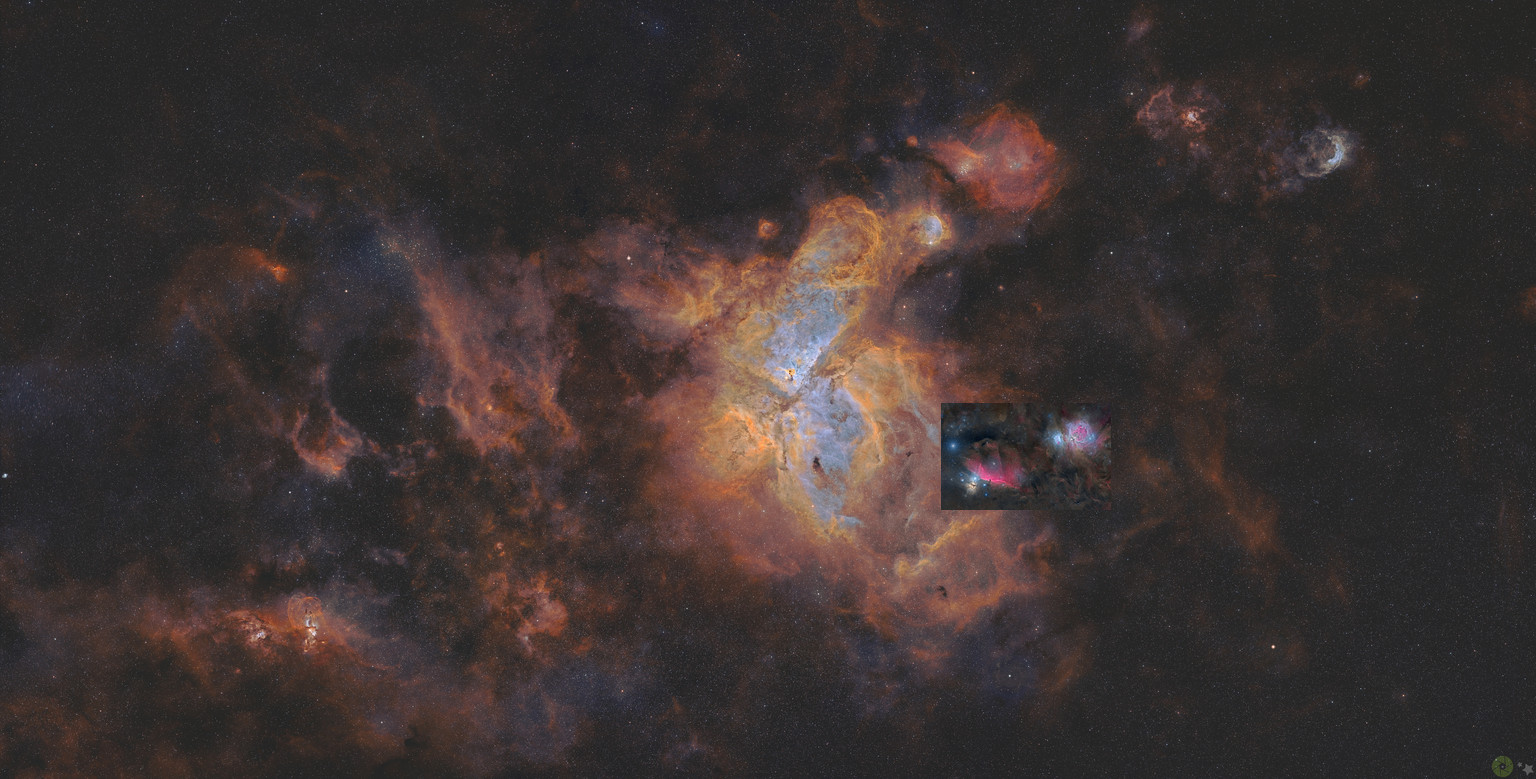
Let’s go back to our familiar M42.
The Orion Nebula is about 1,500 light-years away, while NGC 3372 is roughly five times farther from us.
But when we compare their actual sizes, the difference is even more striking.
M42 extends across a few tens of light-years, while the Great Carina Nebula spans several hundred. The exact figures depend on where we define the boundaries of each nebula.
To give you an idea of the difference, I have prepared a comparison showing M42 at the same physical scale as Carina.
Seen this way, our familiar Great Orion Nebula doesn’t look quite so big anymore.
That doesn’t make it any less interesting, of course. In fact, its relative proximity allows us to study details of star formation that are much harder to resolve in more distant nebulae.
About the Photograph
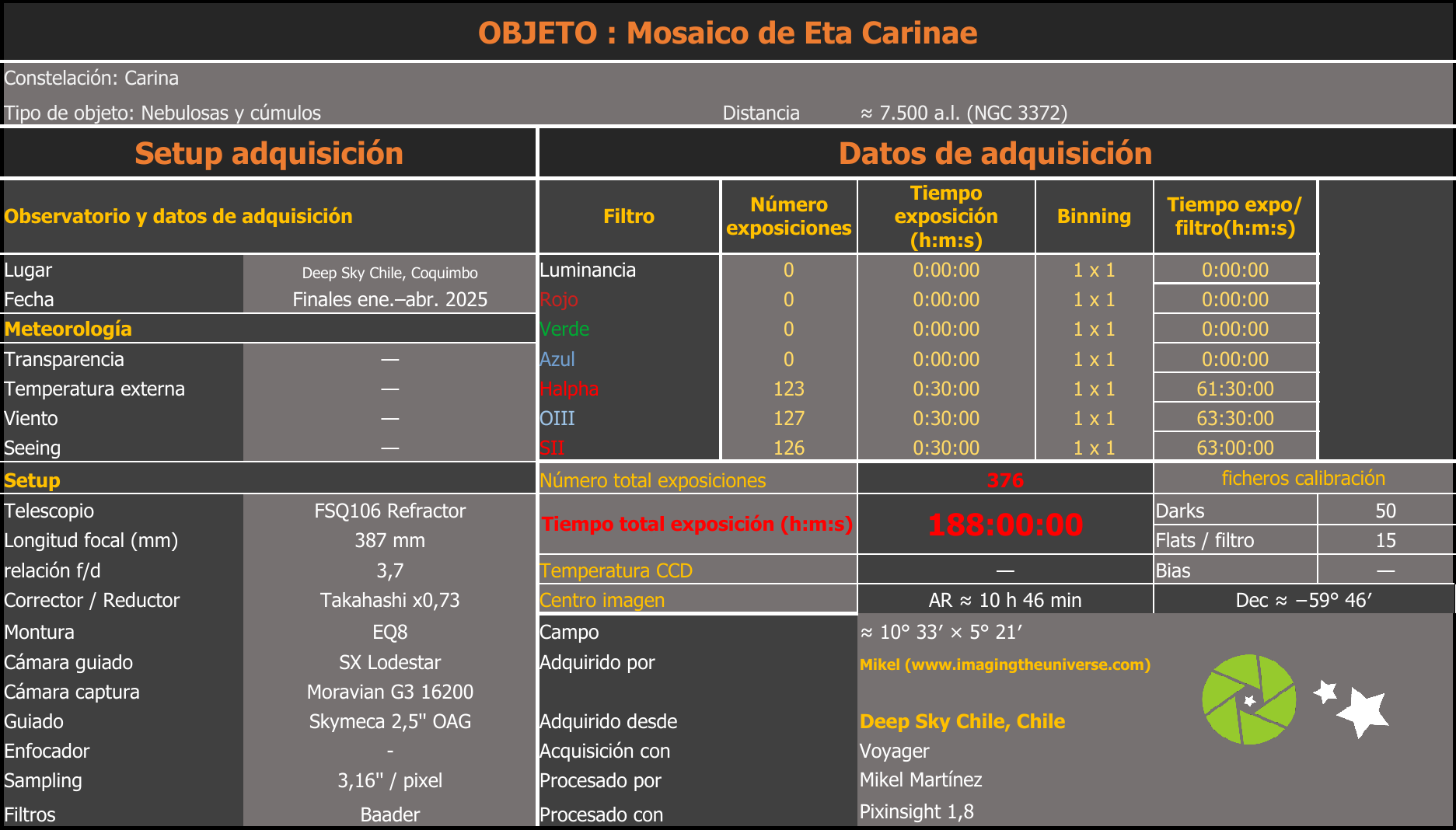
This mosaic consists of six panels captured through Hα, [O III] and [S II] narrowband filters, with a total of 376 exposures of 30 minutes each, adding up to 188 hours of integration time.
Combining the data from these filters allows us to bring out different structures in the nebulae. The colours are not a literal representation of what our eyes would see, but a way of displaying the light recorded through the three filters.
There is also a considerable amount of processing involved in putting together a mosaic of this size, especially when trying to achieve a smooth transition between panels without noticeable differences in background, brightness or colour.
The final image gives us a chance to explore an incredibly rich region of our galaxy, where stars are born, evolve and gradually transform the same clouds of gas and dust from which they formed.